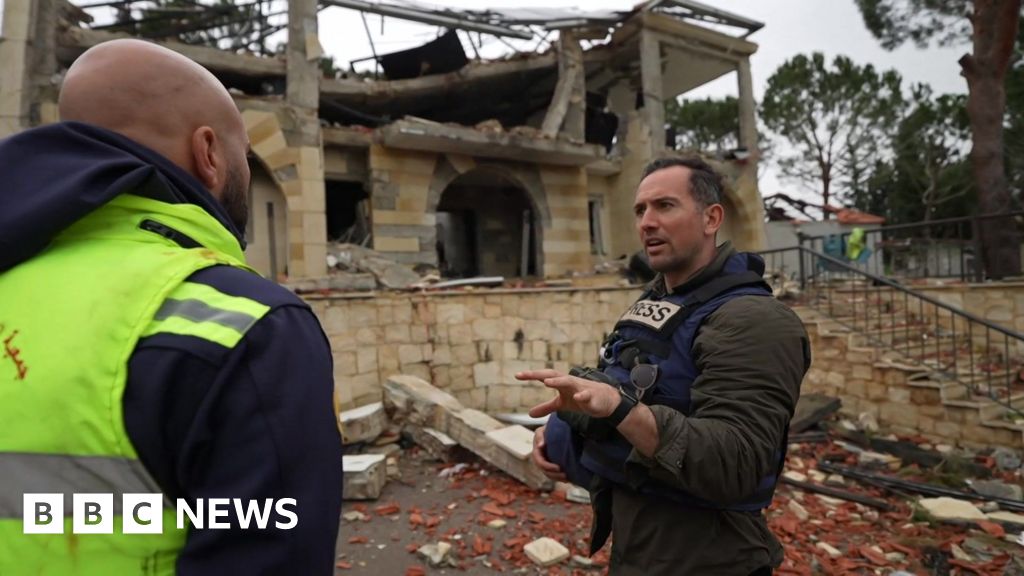
The BBC’s Middle East correspondent Hugo Bachega joins paramedics on duty in Nabatieh, Lebanon – a city that was once vibrant, but is now abandoned.
In Lebanon, one in five people have been forced to leave their homes since fighting renewed in March.
At one ruined ambulance station, a paramedic shows where a colleague was killed by an Israeli strike while he was talking on the phone to his wife.
Israel says some ambulances and health facilities in Lebanon are being used by Hezbollah – but paramedics say there is no evidence of this claim.
Elsewhere, the Israel Defense Forces (IDF) said troops had killed more than 20 Hezbollah fighters operating from a hospital compound in Bint Jbeil on Sunday, the site of fierce fighting during the 2006 war between Israel and Hezbollah.
Lebanon’s health ministry denied the claim, accusing Israel of targeting civilians and medical facilities.
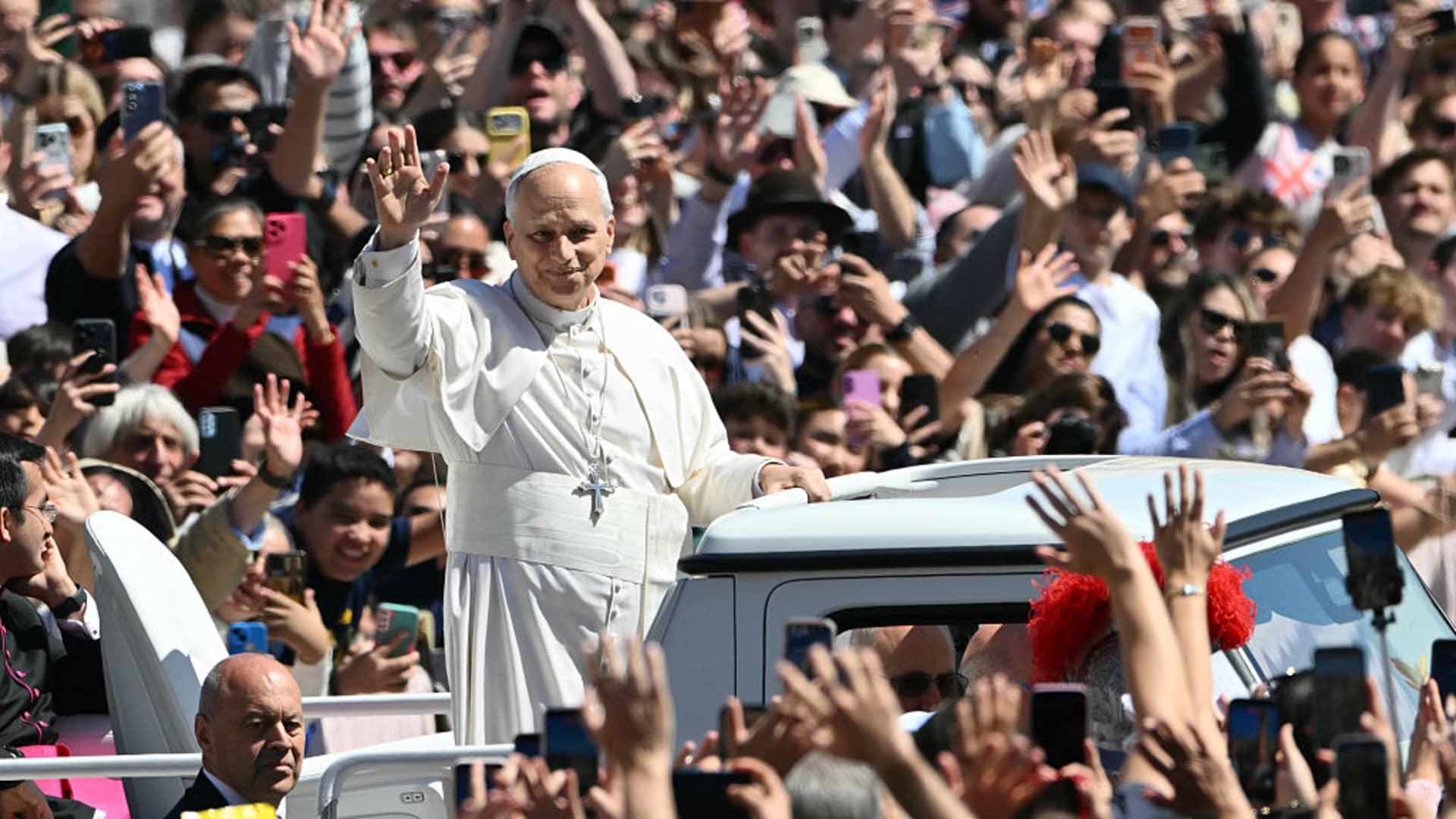
Pope Leo XIV waves to the crowd from the popemobile after the Easter Mass as part of the Holy Week celebrations, at St Peter’s square in the Vatican on April 5, 2026.
Alberto Pizzoli | Afp | Getty Images
Pope Leo XIV fired back at President Donald Trump on Monday, a day after Trump blasted the Catholic pontiff on Truth Social for criticizing the U.S. war against Iran and for military action against Venezuela.
“I have no fear of the Trump administration,” Leo told reporters before boarding a flight to begin a 10-day tour to four African countries.
“I will continue to speak out loudly against war, looking to promote peace, promoting dialogue and multilateral relationships among the states to look for just solutions to problems,” said Leo, who was born in the United States.
He added that he doesn’t want to “get into a debate” with Trump — who took credit for Leo’s election as pope — and that he does not look at his role as “being political.”
“Too many people are suffering in the world today,” Leo said. “Too many innocent people are being killed. And I think someone has to stand up and say there’s a better way.”
Trump’s Truth Social attack on Pope Leo
President Donald Trump on Sunday bashed Leo in a scathing Truth Social post, shortly before posting an image that appeared to depict Trump as Jesus Christ tending to a sick man.
“I do not want a Pope who criticizes the President of the United States because I’m doing exactly what I was elected, IN A LANDSLIDE, to do,” Trump wrote on Truth Social.
“I don’t want a Pope who thinks it’s OK for Iran to have a Nuclear Weapon,” the president wrote. “I don’t want a Pope who thinks it’s terrible that America attacked Venezuela.”
Trump also said, “Leo should be thankful because, as everyone knows, he was a shocking surprise.”
“He wasn’t on any list to be Pope, and was only put there by the Church because he was an American, and they thought that would be the best way to deal with President Donald J. Trump,” the president wrote. “If I wasn’t in the White House, Leo wouldn’t be in the Vatican.”
Read more CNBC politics coverage
Trump also called the pope “weak on Crime, Weak on Nuclear Weapons,” and criticized the pope for recently meeting with former President Barack Obama’s prior political aide, whom Trump said was “a LOSER from the Left.”
Trump’s attack came on the heels of Leo saying on Saturday, “Enough with the idolatry of self and money! Enough with the display of force! Enough with war! True strength is manifested in serving life.”
Leo also had said it was “truly unacceptable” for Trump to make a recent threat that he would destroy “an entire civilization” in Iran.
“I am disheartened that the President chose to write such disparaging words about the Holy Father,” Coakley said late Sunday.
“Pope Leo is not his rival; nor is the Pope a politician. He is the Vicar of Christ who speaks from the truth of the Gospel and for the care of souls.”
Leo’s past criticism of Trump administration policies
Leo’s critique of the Trump administration policies has been going on since last year.
In November, the pope endorsed a message from the U.S. bishops’ conference that said they were “disturbed when we see among our people a climate of fear and anxiety around questions of profiling and immigration enforcement.”
“We bishops advocate for a meaningful reform of our nation’s immigration laws and procedures,” the bishops wrote.
“Human dignity and national security are not in conflict. Both are possible if people of good will work together.”
A smartphone displays the MarineTraffic app showing numerous ship beacons near the Strait of Hormuz with a satellite view in the background, in Creteil, France, on April 8, 2026.
As the 10 a.m. ET deadline passed for the blockade to take effect, President Donald Trump warned Iran’s “fast attack ships” not to come near the U.S. forces enforcing the closure.
“If any of these ships come anywhere close to our BLOCKADE, they will be immediately ELIMINATED, using the same system of kill that we use against the drug dealers on boats at Sea,” Trump wrote on Truth Social. “It is quick and brutal.”
A White House official confirmed to CNBC that the blockade has taken effect.
Trump had announced the blockade plan Sunday in a social media post slamming Iran for refusing to give up its nuclear ambitions and accusing Tehran of “WORLD EXTORTION” by continuing to throttle traffic through the strait.
The U.S. blockade applies to “any and all Ships trying to enter, or leave, the Strait of Hormuz,” Trump said.
The U.S. Central Command later added the caveat that American forces “will not impede freedom of navigation for vessels transiting the Strait of Hormuz to and from non-Iranian ports.”
“The blockade will be enforced impartially against vessels of all nations entering or departing Iranian ports and coastal areas, including all Iranian ports on the Arabian Gulf and Gulf of Oman,” CENTCOM specified.
Trump said in his Truth Social post that other countries will “be involved” with the blockade. But some U.S. allies, including NATO members Britain and France, have already refused to join the effort.
Iranian officials have responded defiantly, warning the U.S. blockade will only drive global energy prices higher.
“Enjoy the current pump figures. With the so-called ‘blockade’, Soon you’ll be nostalgic for $4–$5 gas,” Iran’s parliamentary speaker, Mohammad Bagher Ghalibaf, said in an X post Sunday.
A fragile U.S.-Iran ceasefire, while not officially scrapped, has been deeply frayed as each side has accused the other of violating the conditions of the truce.
The ceasefire was brokered last week, after Trump issued an ultimatum declaring Iran’s “whole civilization will die” if no deal was reached by Tuesday evening.
U.S. negotiators, including Vice President JD Vance, flew to Islamabad for weekend peace talks with Iran, raising hopes that a deal to end the war was at hand.
But Vance said early Sunday that the U.S. delegation would return home without a deal. After 21 hours of of negotiations, Iran still refused to agree not to seek or develop a nuclear weapon, Vance said.
This is developing news. Please check back for updates.
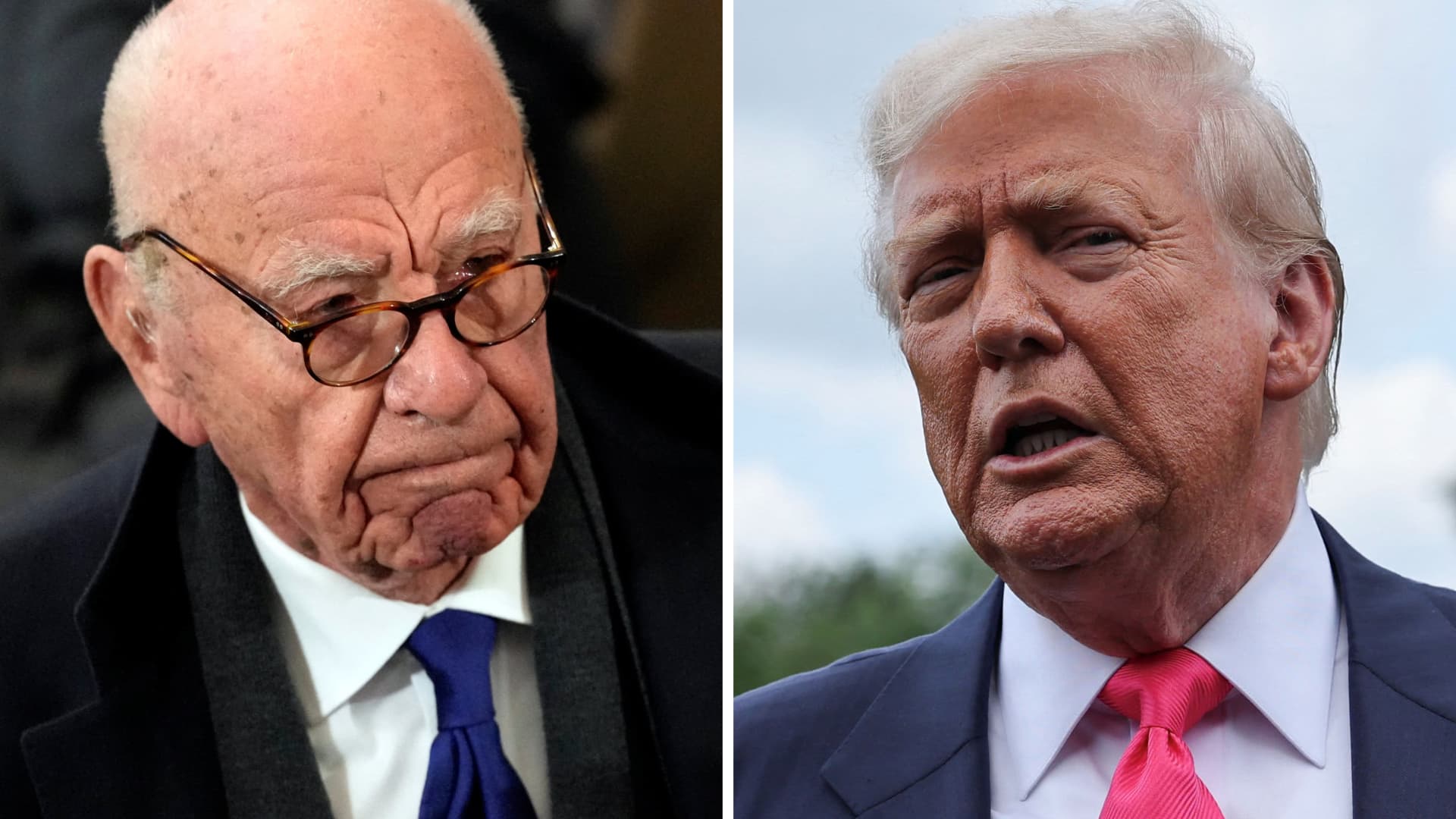
Gayles said he had to dismiss the civil complaint because Trump, who has adamantly denied sending the letter to his then-friend Epstein in 2003, had “not plausibly alleged that the Defendants published the Article with actual malice.”
Plaintiffs who are public figures like Trump must show that a defendant had actual malice when they made allegedly defamatory statements, according to legal precedent.
Gayles said Trump’s complaint “falls short of pleading actual malice,” and also said the president “comes nowhere close to” the standard for showing that the newspaper deliberately avoided investigating the truth of the statements it published about the letter.
“The Article explains that, before running the story, Defendants contacted President Trump, Justice Department officials, and the FBI for comment,” the judge wrote.
“President Trump responded with his denial, the Justice Department did not respond at all, and the FBI declined to comment. In short, the Complaint and Article confirm that Defendants attempted to investigate.”
And Gayles noted that the article included the fact that Trump denied writing the letter, which makes an allegation of actual malice less plausible.
But the judge, in giving Trump a second chance in the case, pointed to another precedent that says a plaintiff “should have the opportunity to amend his complaint” if a lawsuit was tossed out for failing to plead facts in a suit “giving rise to an inference of actual malice.”
The judge’s ruling did not address the question of whether the statements that the Journal made in the article are true, and whether they are defamatory.
Trump plans to refile amended suit on Epstein letter
A spokesman for Trump’s legal team, in a statement, said, “President Trump will follow Judge Gayles’s ruling and guidance to refile this powerhouse lawsuit against the Wall Street Journal and all of the other Defendants.”
“The President will continue to hold accountable those who traffic in Fake News to mislead the American People,” the spokesman said.
The White House declined to comment, referring questions to Trump’s legal team.
CNBC has requested comment from the Wall Street Journal, which is owned by Murdoch’s company, News Corp.
Lawyers for the defendants had in legal filings said Trump’s case should be dismissed because the article about the letter is true, the article is not defamatory, and because Trump had not shown that the newspaper acted with actual malice.
Letter to Epstein showed outline of woman’s body
The Wall Street Journal published an article on July 17 that said a letter bearing Trump’s signature was included in an album of letters that Epstein was giving for his 50th birthday. The article said Trump sent the letter at the request of Epstein’s close friend, Ghislaine Maxwell, who two decades later was convicted of procuring underage girls to be sexually abused by Epstein.
The Journal noted that the letter “contains several lines of typewritten text framed by the outline of a naked woman, which appears to be hand-drawn with a heavy marker.”
Read more about the Jeffrey Epstein files
“A pair of small arcs denotes the woman’s breasts, and the future president’s signature is a squiggly ‘Donald’ below her waist, mimicking pubic hair,” Journal reporters Khadeeja Safdar and Joe Palazzolo said in the article.
“The letter concludes: ‘Happy Birthday — and may every day be another wonderful secret,’” they wrote.
Trump angrily denied writing the letter, saying, “This is not me. This is a fake thing.”
“I never wrote a picture in my life. I don’t draw pictures of women,” the president said at the time.
A day after the Journal published the article, Trump filed a lawsuit against the newspaper, the two reporters, Murdoch, News Corp., the company’s CEO Robert Thompson, and the Journal’s publisher, Dow Jones and Co.
On Sept. 8, Democrats in the House of Representatives released an image of what appeared to be a letter to Epstein signed by Trump, which matched the description of the letter detailed in the Journal’s article. The letter was obtained by the House Oversight and Government Reform Committe after that panel issued a subpoena to Epstein’s estate.
White House Press Secretary Karoline Leavitt, at the time of the release, said it proved that Trump did not draw the picture or sign it.
Epstein killed himself in August 2019 while being held without bail in a Manhattan federal jail. He had been arrested weeks earlier on child sex trafficking charges.
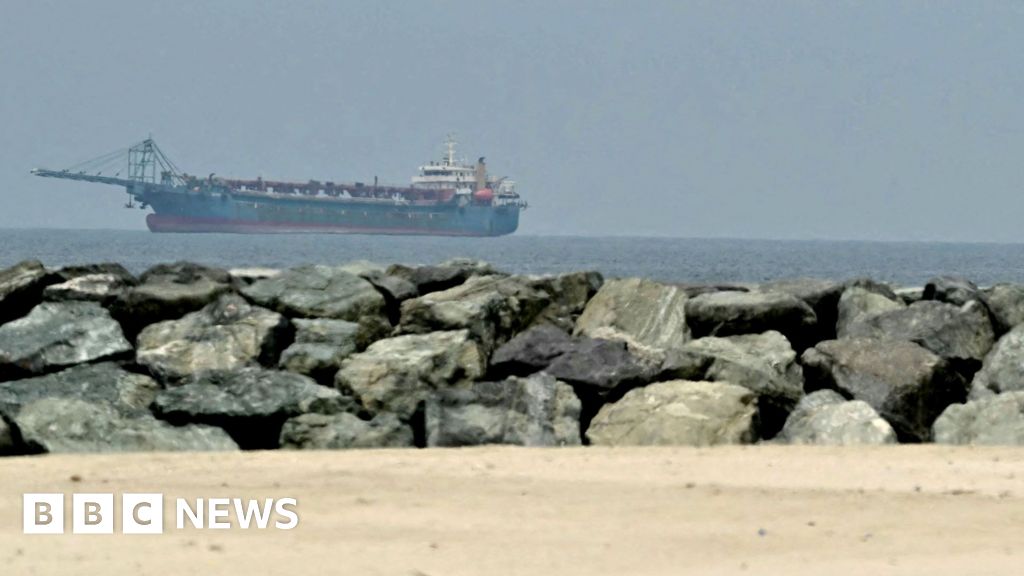
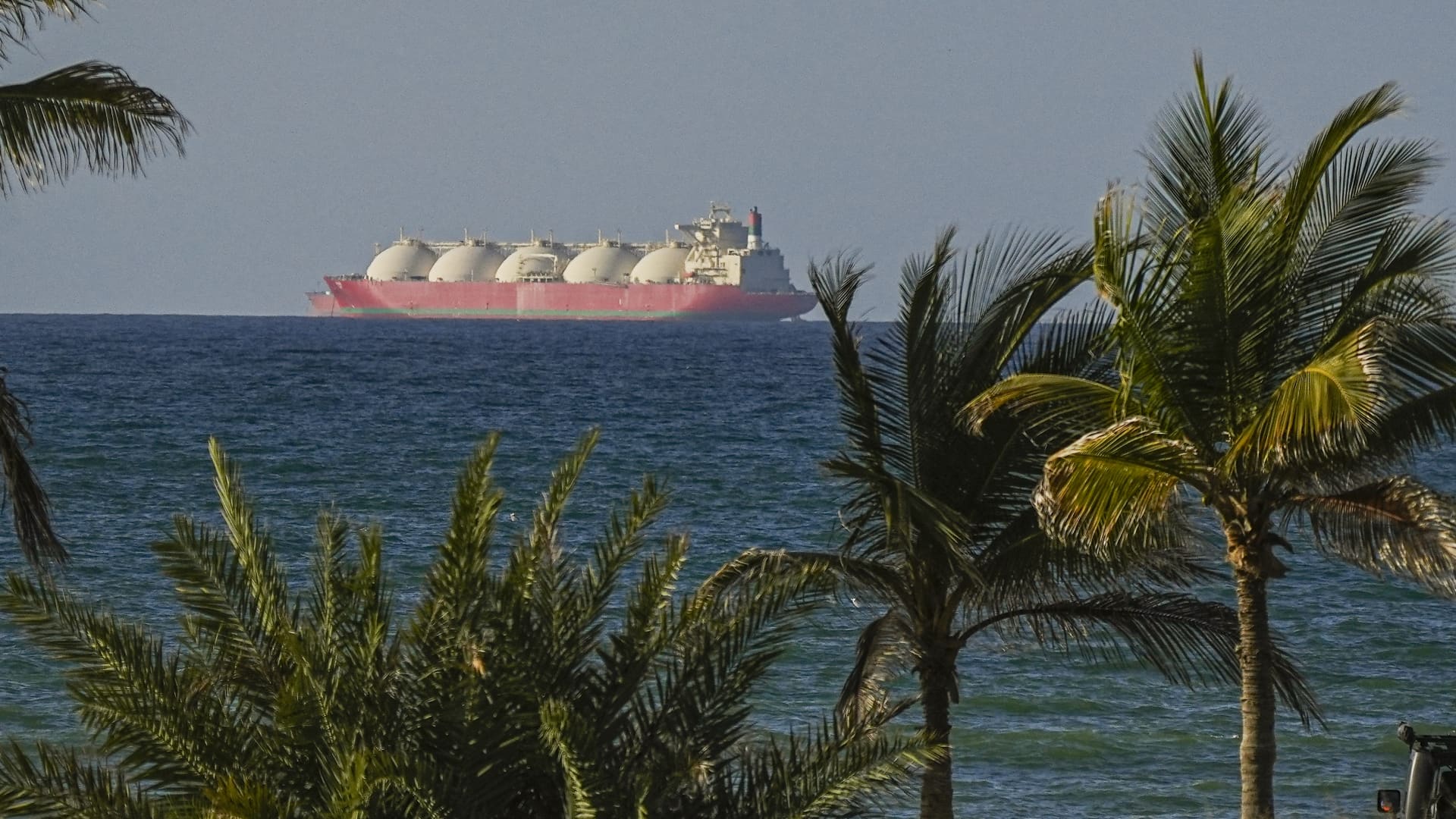
A view of the vessels passing through Strait of Hormuz following the two-week temporary ceasefire reached between the United States and Iran on the condition that the strait be reopened, seen in Oman on April 8, 2026.
Shadi J. H. Alassar | Anadolu | Getty Images
LONDON — European stocks began the week in negative territory as global traders assessed developments in the Middle East over the weekend.
The pan-European Stoxx 600 was almost 0.2% lower at 3:20 p.m. in London (10:20 a.m. ET), with all major bourses sliding and most sectors, oil and gas excepted, in the red.
The U.S. began blocking ships from entering or exiting the Strait of Hormuz at 10 a.m. ET on Monday, in an attempt to pressure Iran to reopen the key oil route.
The move was announced by U.S. President Donald Trump in a post to his social media platform Truth Social on Sunday: “Effective immediately, the United States Navy, the Finest in the World, will begin the process of BLOCKADING any and all Ships trying to enter, or leave, the Strait of Hormuz.”
He added: “The Blockade will begin shortly. Other Countries will be involved with this Blockade. Iran will not be allowed to profit off this Illegal Act of EXTORTION.”
Travel and leisure stocks were among the worst hit, falling 1.2% in afternoon trade, with carriers Wizz Air, EasyJet and Lufthansa down 6.1%, 3.5% and 2%, respectively, as concerns over the supply of jet fuel to European airports rattled markets. Tui was 2.6% lower, while German aircraft engine maker MTU Aero Engines slipped nearly 1%.
In contrast, Vår Energi, the Norwegian oil and gas giant, was up almost 2% in afternoon dealmaking, as energy prices moved above $100 a barrel after Trump announced plans to blockade the Strait of Hormuz. The move was announced after talks between Washington and Tehran at the weekend failed to produce an agreement to end the Middle East conflict.
Global oil benchmark Brent crude last rose 5% on Monday to reach $100.05, and U.S. West Texas Intermediate prices also gained 5% to hit $101.43.
European bourses followed Asia-Pacific stocks lower on Monday as investors reacted to the breakdown of negotiations between Iran and the U.S., which has reignited fears of a prolonged conflict as crude oil prices surged. Separately, President Trump has threatened China with what he called “staggering tariffs” of around 50% should Beijing provide air defense systems, arms and other military assistance to Iran, potentially stoking tensions further.
Elsewhere, European investors are keeping an eye on Hungary after long-term conservative leader Viktor Orban conceded defeat to Peter Magyar’s pro-EU Tisza following the opposition party’s landslide election win. The victory is a blow for Russia and the Trump administration, which saw an ally in Eurosceptic Orban. Hungary’s forint rallied following the result, strengthened 2.51% against the dollar to 313.7 forint, and 2.42% against euro.
Earnings come from LVMH, Christian Dior and Galp Energia on Monday. There are no major data releases.
Nemes Laszl | Science Photo Library | Getty Images
Revolution Medicines‘ drug for pancreatic cancer succeeded in a highly anticipated Phase 3 trial, almost doubling the typical length of survival and slashing the risk of death by 60% versus chemotherapy, the company said Monday.
RevMed said its daily pill, daraxonrasib, met all primary and secondary endpoints in a trial of people whose cancer had already progressed on another treatment. People who took daraxonrasib typically lived for 13.2 months versus 6.7 months for people who took chemotherapy, an increase of 6.5 months, RevMed said in a press release.
“These are dramatic, practice-changing outcomes, and our focus now is moving quickly to bring this potential new treatment option to patients who urgently need new treatment,” RevMed CEO Mark Goldsmith said in an interview.
Goldsmith called the results “unprecedented,” saying no drug has shown an overall survival benefit greater than one year in a Phase 3 trial for pancreatic cancer. The company plans to soon seek Food and Drug Administration approval using a Commissioner’s National Priority Voucher, which grants a review within a matter of months.
RevMed’s pill could bring a new option for people with pancreatic cancer, an aggressive disease that has the lowest five-year survival rate of any major cancer, at 13%. Daraxonrasib broadly targets RAS mutations, which drive tumor growth and are found in about 90% of pancreatic cancer cases.
“These results usher in a new era of RAS-targeted medicines for pancreatic cancer, which has been exclusively treated with cytotoxic intravenous chemotherapy,” Goldsmith said.
The company’s shares jumped more than 30% following release of the results Monday.
RevMed said the drug showed a manageable safety profile and that no new concerns were observed. The drug can produce rash, a side effect highlighted last week by former Republican Sen. Ben Sasse, who shared his experience taking the drug in an interview with The New York Times. Goldsmith said the company can’t comment on any individual patient, but that a rash is a known side effect and one that’s generally manageable.
The company will seek approval for second-line treatment, or in patients whose cancer has already spread while taking another drug. It’s conducting a Phase 3 trial for newly diagnosed patients.