“Fidesz rule has to stop, they stole a lot and the country’s dying,” says Eva, who believes 90% of people in the market still back them. “Tisza supporters only see the bad things about Orbán,” Andrea retorts. “If you look around in the city, they renovated six schools, and built new buildings in the hospital.” That may be true, Eva argues, but she alleges a lot of the money for it disappeared.
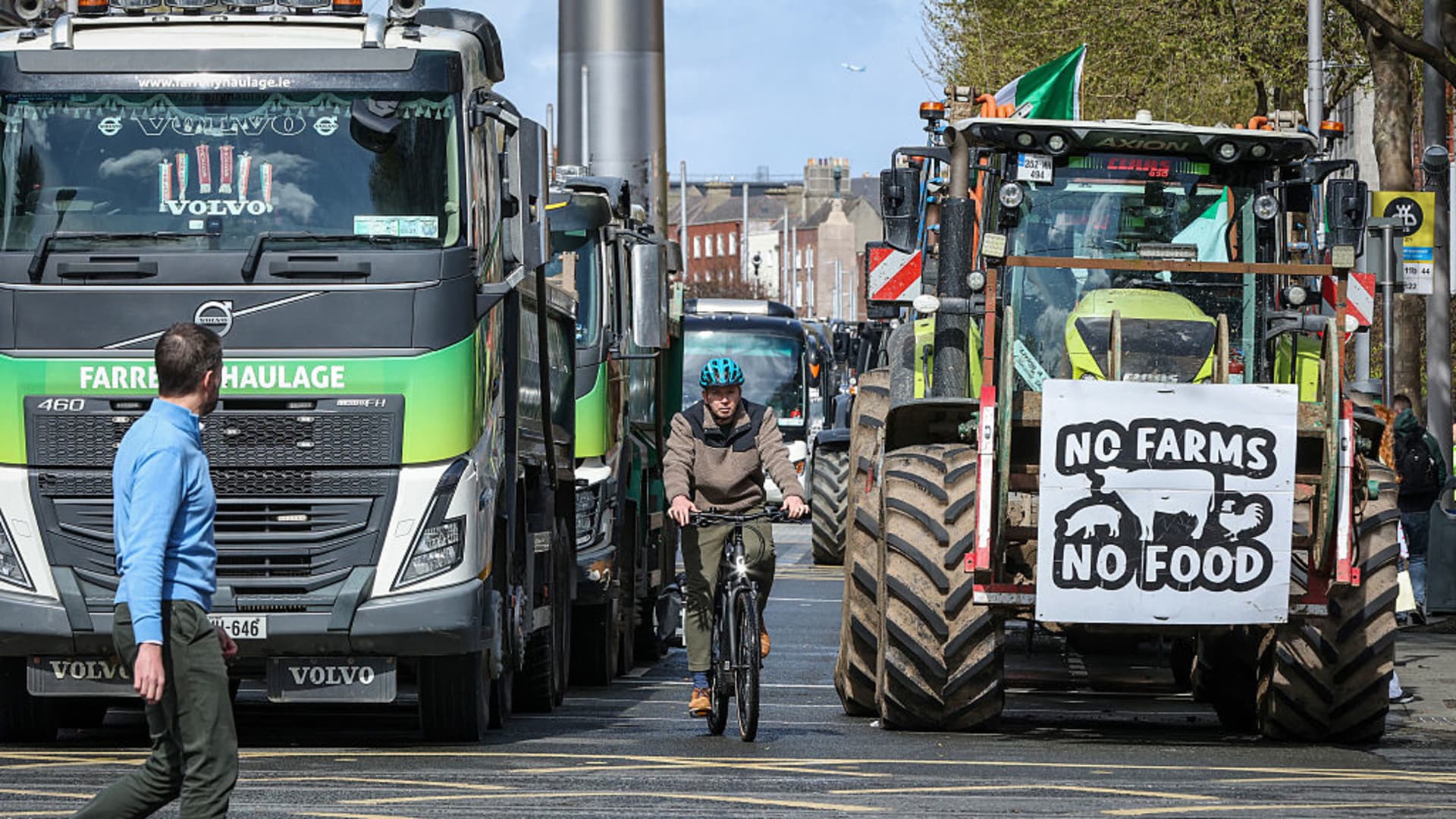
Trucks and tractors block O’Connell Street in the centre of the city, as protests continue for a third day against the rising cost of fuel due to the Middle East crisis, in central Dublin on April 9, 2026. (Photo by Paul Faith / AFP via Getty Images)
Paul Faith | Afp | Getty Images
Protests around fuel prices in Ireland are entering their fourth day, with three of the country’s main refineries and terminals blockaded, and traffic in Dublin at a standstill.
The demonstrations have been primarily instigated by farmers, agricultural contractors and road haulage operators, who are upset with the government’s response to the spike in fuel prices since the onset of the Iran war.
However, recognized industry bodies, including the Irish Farmers’ Association and the Irish Road Haulage Association, are not involved.
Countries around the world are grappling with higher fuel prices as a result of the Middle East conflict. British Prime Minister Keir Starmer said Thursday he was “fed up” seeing energy bills in the U.K. fluctuate because of actions taken by U.S. President Donald Trump and Russian President Vladimir Putin.
Oil prices were off their highs on Friday as shipping flows around the Strait of Hormuz remained severely restricted.
Fuel protesters block the motorway outside Dundalk as protests continue for a third day against the rising cost of fuel due to the Middle East crisis across the country on April 9, 2026. (Photo by Paul Faith / AFP via Getty Images)
Paul Faith | Afp | Getty Images
The standoff in Ireland has seen petrol pumps in forecourts across the country run dry, with demonstrators claiming they will remain in place until they secure a meeting with the government to air their grievances over what they claim is a lack of support from authorities.
The government has asked the country’s army to be on standby to remove blockades at terminals and refineries. Taoiseach — Irish for leader — Micheál Martin has described the protests as an “act of national sabotage,” adding that he can’t comprehend the logic of blocking access to fuel in the midst of a surge in prices.
The Irish government announced in March a 250-million-euro ($293 million) package of measures to help households and businesses tackle the spike in prices, including a cut in excise duty on both diesel and petrol.
“We will navigate this period of volatility. But, to put it bluntly, nobody knows what the situation will be in a month from now; we must remain flexible in our response,” Ireland’s Finance Minister Simon Harris, said at the time.
A man sits in the wheel of a tractor as fuel protestors block O’Connell Street in the centre of the city, as protests continue for a third day against the rising cost of fuel due to the Middle East crisis, in central Dublin on April 9, 2026. (Photo by Paul Faith / AFP via Getty Images)
Paul Faith | Afp | Getty Images
Government officials are due to meet with industry bodies on Friday to discuss the crisis, but Defense Minister Helen McEntee has confirmed that those protesting have not been given an invitation.
In a bid to cope with the fallout of the energy shock, governments around the world have been quick to impose measures from fuel export bans to loosening refining standards. The U.K. government last month introduced rules requiring developers to install heat pumps and solar panels in all new homes across England, while Greece has capped profit margins on fuel and supermarket products for three months.
Shares in Europe closed higher on Friday afternoon as investors weighed the fragile ceasefire between the U.S. and Iran, and the potential for successful peace negotiations in Ukraine.
The pan-European Stoxx 600 index ended the session 0.4% higher, with most regional sectors and all major bourses closing in positive territory.
European defense stocks fell sharply after Ukraine’s senior negotiator with Russia signaled that a resolution to the conflict could be in sight.
Rheinmetall, Germany’s largest arms maker, finished the day 5.9% lower, while tank manufacturer Renk was 3.9% lower and Hensoldt, the military tech and surveillance specialist, closed down 5.9%. Other defense stocks in the red included Swedish fighter jet maker Saab, which dipped 2.2%, and the U.K.’s BAE Systems, which closed the session 3.3% lower.
Kyrylo Budanov, a former military spy and one of Ukrainian president Volodymyr Zelenskiy’s key aides, expressed optimism that negotiations could be nearing a settlement, according to a Bloomberg report Friday.
On Thursday, Israeli Prime Minister Benjamin Netanyahu said that the country had agreed to negotiate with Lebanon “as soon as possible.” Tehran’s parliamentary speaker Mohammad Bagher Ghalibaf cited Israel’s continued attacks on Lebanon as a violation of the ceasefire agreement between the U.S. and Iran.
Asian markets rose overnight following the news, with South Korea’s Kospi advancing 1.75%, while the small-cap Kosdaq was 1.65% higher.
Japan’s Nikkei 225 gained 1.88%, while the Topix was flat. Japanese Prime Minister Sanae Takaichi said Friday that the country plans to release 20 days’ worth of oil reserves from May onwards, Reuters reported. Japan had enough oil reserves for 230 days as of April 6.
German inflation accelerated to 2.8% in March, according to data released Friday, confirming provisional results.
“The significant increase in the prices of energy products is driving up inflation,” said Ruth Brand, President of the Federal Statistical Office. “In particular, motor fuel and heating oil prices have risen sharply for consumers since the start of the Iran war.”
In the U.S., meanwhile, the latest consumer price index print rose 0.9% for the month of March, which pushed the annual CPI inflation rate to 3.3%, driven by the jump in oil prices.