[ad_1]
The world waits for Trump’s verdict after the talks failed to yield a deal, writes the BBC’s Lyse Doucet.
[ad_2]
Source link
Blog
-

After Iran talks falter, will Trump escalate or negotiate?
-

How Hungary’s knife-edge election could impact the US and Russia
[ad_1]
Hungarian Prime Minister Viktor Orbán has been in power for 16 years.
As a friend to both Russian President Vladimir Putin and US President Donald Trump, there is much international attention on the country’s 12 April elections.
The BBC’s Europe Editor Katya Adler reports from Orbán’s home town of Felcsút on why the knife-edge vote matters to the US and Russia.
[ad_2]
Source link -

Justin Bieber headlines Coachella with nostalgia-fuelled set
[ad_1]
The star spent much of the gig singing along to YouTube videos of early hits like Baby and Never say Never.
[ad_2]
Source link -
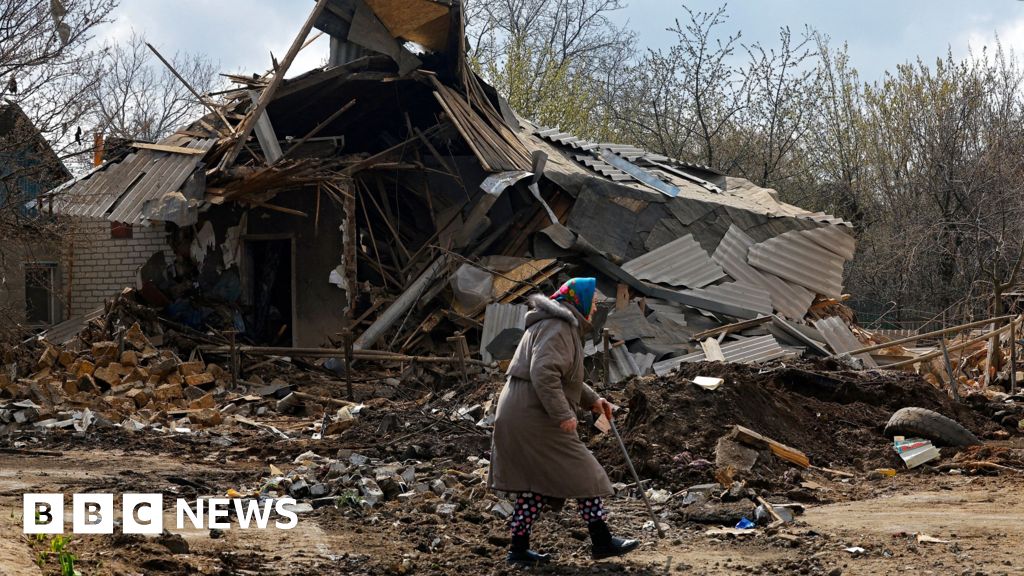
Ukraine and Russia accuse each other of hundreds of ceasefire violations
[ad_1]
Ukrainian President Volodymyr Zelensky says his nation’s forces would respond “symmetrically” to Russian attacks.
[ad_2]
Source link -

Asha Bhosle: The sound of Bollywood dies aged 92
[ad_1]
Her infectious voice got fans dancing and singing, becoming the soundtrack for generations of Indians.
[ad_2]
Source link -

At least 30 feared dead in crush at Haitian tourist site
[ad_1]
The incident occurred at a “tourist event attended by many young people”, Haiti’s prime minister says.
[ad_2]
Source link -
How to help kids form healthy relationships with money: psychologist
[ad_1]
As parents contend with rising costs and an overall tighter economic climate, more of them are using those challenges as an opportunity to have frank talks with their kids about money, according to a recent survey.
Honest conversations — including telling your kids “no” when they ask you to buy something, and explaining why — can give those kids an early foundation of financial literacy that can serve them well later in life, says Brad Klontz, a financial psychologist, author and associate economics professor at Creighton University.
In the survey of 2,000 U.S. parents, released March 31 by financial software company Intuit, almost two-thirds — 64% — of parents raising kids under age 18 said that recent financial challenges forced them to be more transparent with their children about how they manage their finances. Sixty-six percent of respondents reported saying “no” to purchase requests more often while explaining their reasoning to their kids.
Kids don’t always learn much about money in school: As of March 2026, 39 U.S. states make passing a personal finance course a requirement of high school graduation, which is up from just 12 states in 2022, according to the Council for Economic Education.
DON’T MISS: The leadership skills that can help you stand out at work
Yet children can start learning permanent money habits as early as age 5, research shows. And kids who learn financial literacy early on are more likely to form healthy relationships with money that can help improve their financial and overall well-being as adults, according to a 2022 study by researchers at Brigham Young University.
You might explain to a young child that an expensive video game console doesn’t fit in your family’s budget, or catch your teenager up on how you’ve put aside funds for their college education. When parents talk to their kids about money, “those kids end up in much better financial shape later on in life, versus having to learn it the hard way,” says Klontz.
Shutting down your child’s money questions is a ‘big mistake’
Many parents find money discussions with kids to be taboo, particularly specifics about their own family’s financial status and spending habits, studies show. Some parents feel ashamed about the state of their own financial literacy, and anxiety over money being tight can cause parents to avoid discussing the subject, Klontz says.
But avoidance is a “big mistake” when it comes to discussing money with your kids, says Klontz: Never shut down your child’s questions about the topic, even if they’re asking for a purchase that’s not within your family’s financial reach at the moment. Saying “no” to your child’s latest spending request is a prime opportunity to follow up with some thoughtful and informative reasoning for that decision, he adds.
“You don’t want to give your kids the message that this is a stressful, taboo topic that ‘we don’t talk about,’” says Klontz. Such an approach can harm kids’ long-term financial literacy, he says, especially if they grow into adults who don’t talk, or even think, about their own budgeting plans.
Explain to your children what your family chooses to spend money on and why, and what you’re doing with money you don’t spend — like investing or saving for important or fun future purchases, Klontz recommends. “Sit down and say, ‘Hey, we want a new TV, or we have this other financial goal, so … we’re going to set aside X amount of money each paycheck,’” he says.
You can impart your financial values and goals to your children while showing the specific path you’re taking to achieve them, says Klontz. Otherwise, “you might be saving in the background, but they never saw it. You never had them save for anything. That’s a huge error that we make as parents.”
Offer practical lessons, don’t over-share
More than half of parents in the Intuit survey said they take their kids grocery shopping to give them a first-hand look at regular household costs, and 38% said they talk to their kids about regular expenses like rent, mortgage or utility payments. Those practical lessons help teach kids to be thoughtful about prices and how much you’re saving for future purchases, personal finance experts say.
“When you’re walking through a store and your child wants something, pick it up [and] show them the price,” Alexa von Tobel, founder and managing partner of venture fund Inspired Capital, told CNBC Make It in February 2024. “‘This costs $29. Mommy doesn’t have the $29 for this today, but we can think about saving that for your birthday.’”
Klontz offers one “caveat” to the transparency strategy: Design your conversations to be age-appropriate, and not too stressful. Elementary school-aged children can be expected to understand basic money concepts about the value of money, and the concept of cost factoring into what you buy, family wealth experts say. Middle school students might be more prepared to discuss complex concepts like budgeting and long-term saving.
Just be careful: Scaring or stressing your kids unnecessarily can cause them to develop unhealthy relationships with money, says Klontz. If money is tighter than usual, offer a matter-of-fact explanation of why your family might cut back on certain expenses for the meantime while reiterating that everything will ultimately be fine for them and the family, he advises.
“You might be passing on some of this fear [and] anxiety, and that plays itself out in very detrimental ways later on in life,” Klontz says. If you lie to them, you may face another issue, he notes: “Kids have really good bullshit detectors. I think it’s fine to say: ‘Look this is stressful, and we’re not exactly sure what’s going on. But, trust me … we’ve got this.’”
Want to lead with confidence and bring out the best in your team? Take CNBC’s new online course, How To Be A Standout Leader. Expert instructors share practical strategies to help you build trust, communicate clearly and motivate other people to do their best work. Sign up today!

[ad_2]
Source link -

'We need real peace': Easter truce fails to lift grim mood in war-torn Ukraine
[ad_1]
Easter festivities are muted in Kharkiv as Ukrainians expect fighting to flare up again after a weekend truce.
[ad_2]
Source link -
Vance to return to the U.S. without a deal with Iran to end the war
[ad_1]
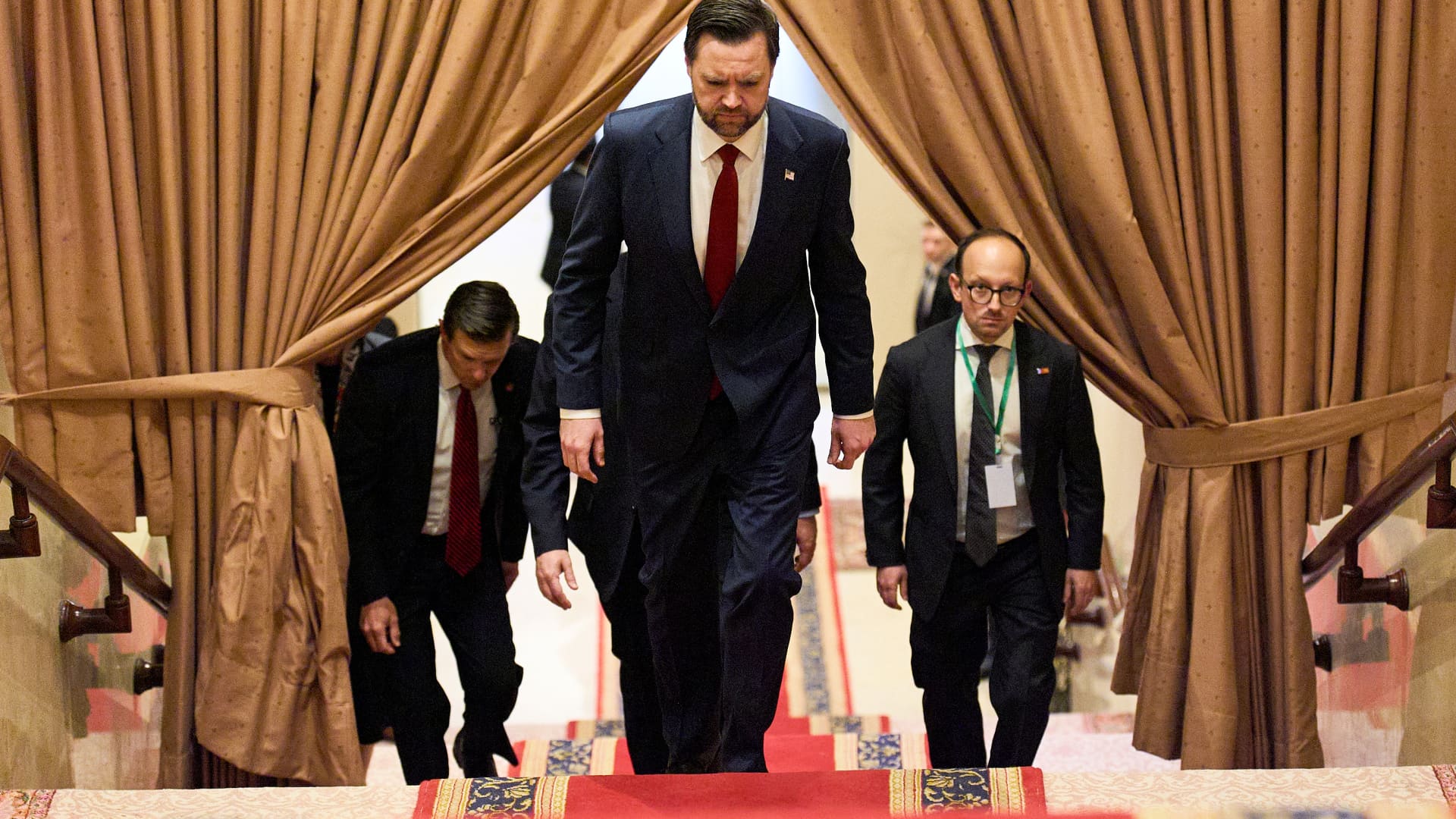
ISLAMABAD, PAKISTAN – APRIL 11: U.S. Vice President JD Vance (C) walks with Pakistan’s Chief of Defence Forces and Chief of Army Staff Field Marshall Asim Munir (L), and Pakistani Deputy Prime Minister and Foreign Minister Mohammad Ishaq Dar after arriving for talks with Iranian officials on April 11, 2026 at Islamabad, Pakistan. (Photo by Jacquelyn Martin – Pool/Getty Images)
Pool | Getty Images News | Getty Images
Vice President JD Vance said early on Sunday in Pakistan that U.S. officials are leaving peace talks after the Iranian delegation refused to agree not to develop a nuclear weapon.
“We have been at it now for 21 hours, and we’ve had a number of substantive discussions with the Iranians. That’s the good news,” he said in a press conference following the talks. “The bad news is that we have not reached an agreement.”
The key sticking point, Vance said, was on the issue of Iran’s unwillingness to give up its pursuit of nuclear weapons.
“We need to see an affirmative commitment that they will not seek a nuclear weapon, and they will not seek the tools that would enable them to quickly achieve a nuclear weapon,” he said, noting it is the “core goal” that President Donald Trump hoped to achieve with the negotiations. “They have chosen not to accept our terms.”
The vice president said he spoke with Trump “a half dozen times, a dozen times, over the past 21 hours,” as well as with Secretary of State Marco Rubio, Treasury Secretary Scott Bessent and Adm. Brad Cooper, head of the U.S. Central Command.
“We were constantly in communication with the team because we were negotiating in good faith,” Vance said, speaking at a podium alongside special envoy Steve Witkoff and Trump’s son-in-law, Jared Kushner.
“We leave here with a very simple proposal, a method of understanding that is our final and best offer. We’ll see if the Iranians accept it,” he said. A short time later, the vice president waved goodbye from the top of the stairs as he boarded Air Force Two in Islamabad.
Various Iranian state media reports cited stark differences in negotiations for the breakdown in the talks, including the removal of nuclear materials from the country and the reopening of the Strait of Hormuz. Iran’s Tasnim news agency said that “excessive” U.S. demands had hindered efforts to reach an agreement.
The historic talks ended days after the fragile, two-week ceasefire was announced. Vance’s comments did not indicate what would happen after that period expired or whether the ceasefire would remain in place.
The Iranian delegation, led by Parliament Speaker Mohammad Bagher Qalibaf, discussed with their U.S. and Pakistani counterparts how to advance the ceasefire already threatened by deep disagreements and Israel’s continued attacks against the Iranian-backed Hezbollah in Lebanon, whose health ministry said the death toll has surpassed 2,000.
The Iranian delegation arrived dressed in black in mourning for late Supreme Leader Ayatollah Ali Khamenei and others killed in the war. They carried shoes and bags of some students killed during the U.S. bombing of a school next to a military compound, the Iranian government said. The Pentagon has said the strike is under investigation.
“There were mood swings from the two sides and the temperature went up and down during the meeting,” one Pakistani source told Reuters in reference to the first round of talks.
For the U.S.-Iran talks, Islamabad, a city of more than 2 million people, was locked down with thousands of paramilitary personnel and army troops on the streets.
U.S. destroyers transit the Strait of Hormuz
The peace talks took place as two American warships transited through the Strait of Hormuz for the first time since the start of the conflict. The U.S. Central Command said the warships were taking part in a mission to clear the waterway of sea mines put in place by Iran.
The ceasefire between the U.S. and Iran that began Tuesday has come under strain as Iran continues to block most shipping traffic through the strait, the world’s most critical chokepoint for oil and gas supplies.
U.S. Central Command said that forces began setting conditions for clearing mines in the strait, as two U.S. Navy guided-missile destroyers conducted operations. The USS Frank E. Peterson and the USS Michael Murphy transited the strait and operated in the Arabian Gulf as part of a broader mission to clear sea mines previously laid by Iran’s Islamic Revolutionary Guards Corps, Defense Secretary Pete Hegseth said in a post on X.
“Today, we began the process of establishing a new passage and we will share this safe pathway with the maritime industry soon to encourage the free flow of commerce,” Adm. Brad Cooper, commander of CENTCOM, said in a statement.
“We’re sweeping the strait. Whether we make a deal or not makes no difference to me,” U.S. President Donald Trump told journalists as high-stakes talks continued into the night and the time approached 2 a.m. in Pakistan.
Iran’s state media, however, earlier said Iran forced a U.S. military ship that was attempting to cross the strait to turn around. MS Now later reported that commercial maritime traffic systems showing the USS Michael Murphy crossing the Strait of Hormuz into the Persian Gulf weren’t reliable.
Late Saturday, Iran’s Islamic Revolutionary Guard Corps warned that any attempt by military vessels to transit the Strait of Hormuz would be met with “a strong response.” Only non-military vessels would be allowed to pass under specific regulations, the IRGC said in a statement carried by Iranian media.
Separately, a senior Iranian source told Reuters the U.S. had agreed to release frozen assets held in Qatar and other foreign banks, but a U.S. official immediately denied the report.
Tankers exit the Gulf via the strait
Three supertankers passed through the Strait of Hormuz on Saturday, shipping data showed, marking what appeared to be the first vessels to exit the Gulf since the U.S.-Iran ceasefire deal.
Tehran’s blockade of the strait, a chokepoint for about 20% of global oil and liquefied natural gas shipments, since the start of the Iran war at the end of February, has disrupted global energy supplies and sent oil prices soaring.
The Liberia-flagged Very Large Crude Carrier (VLCC) Serifos and China-flagged VLCCs Cospearl Lake and He Rong Hai, entered and exited the “Hormuz Passage trial anchorage” that bypasses Iran’s Larak Island on Saturday, LSEG data showed.

Each vessel is capable of carrying 2 million barrels of oil.
Serifos, carrying crude loaded from Saudi Arabia and the United Arab Emirates in early March, is expected to arrive at Malaysia’s Malacca port on April 21, data from LSEG and analytics firm Kpler showed.
Cospearl Lake is laden with Iraqi oil and He Rong Hai is carrying Saudi crude, the same data showed.
Both VLCCs are chartered by Unipec, the trading arm of Chinese energy giant Sinopec, according to the data.
Trump’s frustration with Iran
Trump has expressed frustration with Iran continuing to block most shipping traffic through the Strait of Hormuz.
In an announcement Tuesday evening, Trump said that the U.S. would agree to a two-week suspension of hostilities subject to Iran agreeing to a complete and immediate reopening of the Strait of Hormuz.
But since then, vessel traffic through the strait remains nearly as tightly throttled as it has been since the war began on Feb. 28.
In a Truth Social post on Thursday evening, Trump fumed, “There are reports that Iran is charging fees to tankers going through the Hormuz Strait — They better not be and, if they are, they better stop now!”
Iran “is doing a very poor job, dishonorable some would say, of allowing Oil to go through the Strait of Hormuz,” the president wrote in a follow-up post. “That is not the agreement we have!”
Israel and Lebanon will have direct negotiations
Negotiations between Israel and Lebanon are expected to begin Tuesday in Washington, Lebanese President Joseph Aoun’s office said Friday, after Israel’s surprise announcement authorizing talks despite the countries’ lack of official relations.
But thousands in Lebanon protested the planned negotiations, and Prime Minister Nawaf Salam said he had postponed a planned trip to Washington “in light of the current internal circumstances.” It was not immediately clear what that meant for the talks.
Israel wants the Lebanese government to assume responsibility for disarming Hezbollah, much like was envisaged in a November 2024 ceasefire. But it is unclear whether Lebanon’s army can confiscate weapons from the militant group, which has survived efforts to curb its strength for decades.
Israel’s insistence that the ceasefire in Iran does not include a pause in its fighting with Hezbollah has threatened to sink the deal. The militant group joined the war in support of Iran in the opening days. Israel followed up with airstrikes and a ground invasion.
The day the Iran ceasefire deal was announced, Israel pounded Beirut with airstrikes, killing more than 300 people in the deadliest day in Lebanon since the war began, according to the country’s Health Ministry.
Qatar to fully resume maritime navigation activities
Qatar’s Ministry of Transport announced the full resumption of maritime navigation activities effective Sunday from 6 a.m. to 6 p.m. local time, extending the decision to “all categories of marine vessels and transport modes.”
The ministry urged operators in a statement to comply with safety protocols.
It was not immediately clear whether the decision meant that Qatari vessels would be allowed to transit the Strait of Hormuz, which remained effectively closed.
Pope Leo blasts ‘delusion of omnipotence’ fueling war
In his strongest words yet, Pope Leo XIV denounced the “delusion of omnipotence” that is fueling the U.S.-Israel war in Iran and demanded that political leaders stop and negotiate peace.
Leo presided over an evening prayer service in St. Peter’s Basilica on the same day the United States and Iran began face-to-face negotiations in Pakistan and as a fragile ceasefire held.
History’s first U.S.-born pope didn’t mention the U.S. or Trump in his prayer, which was planned before the talks were announced. But Leo’s tone and message appeared directed at Trump and U.S. officials, who have boasted of U.S. military superiority and justified the war in religious terms.
“Enough of the idolatry of self and money!” Leo said. “Enough of the display of power! Enough of war!”
In the basilica pews was the archbishop of Tehran, Belgian Cardinal Dominique Joseph Mathieu. The U.S. was represented in the diplomatic corps by its deputy chief of mission, Laura Hochla, the U.S. Embassy said.
— Reuters and the Associated Press contributed to this report
[ad_2]
Source link -
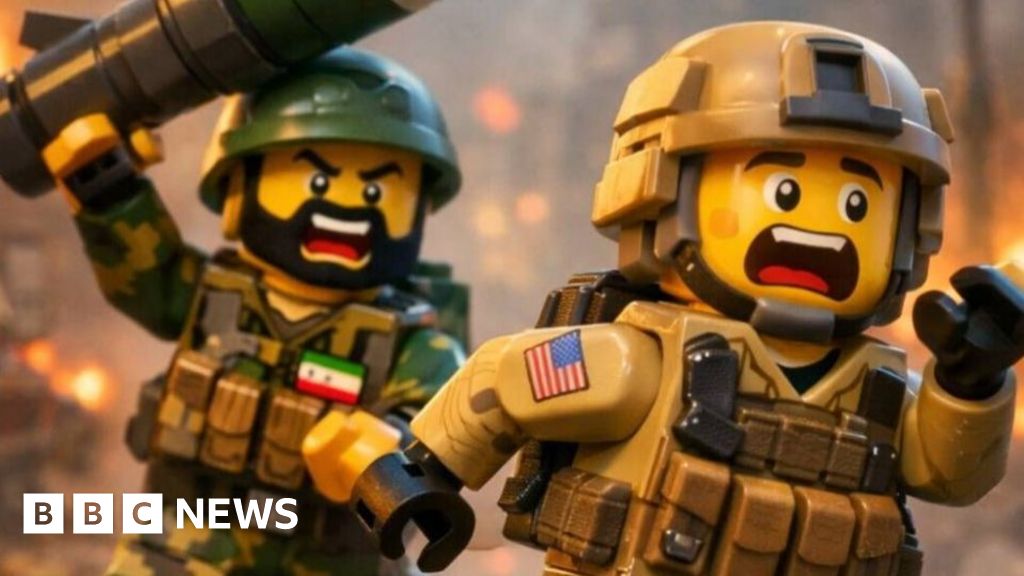
We spoke to the man making viral Lego-style AI videos for Iran. Experts say it's powerful propaganda
[ad_1]
“Slopaganda” is too weak a term to capture how powerful this “highly sophisticated” content is, one expert says.
[ad_2]
Source link